What haircut suits my face shape?
The short version: oval faces suit almost anything and mainly need their balance left alone; round faces want height and vertical lines; square faces want softness around a strong jaw; heart faces want weight below the cheekbones; diamond faces want width at the forehead and chin; oblong faces want width and a shortened forehead.
Every one of those is a single principle — add where you are narrow, soften where you are angular, do not add width where you are already widest — applied to a different starting shape. Once you know your shape, you can evaluate any cut yourself instead of memorising a list.
On this page
First, measure your face shape
You need a mirror, a soft tape measure (or a piece of string and a ruler), and your hair pulled fully back. Take four measurements:
- Forehead: across the widest point, roughly halfway between your eyebrows and your hairline.
- Cheekbones: from the outer corner of one eye, across the top of the cheekbone, to the other.
- Jawline: from below one ear, along the jaw, to the tip of the chin — then double it.
- Face length: from the centre of your hairline straight down to the bottom of your chin.
Now compare them:
| If… | Your shape is |
|---|---|
| Length is clearly greater than width; cheekbones widest; jaw slightly narrower than forehead; chin rounded | Oval |
| Length and width are close to equal; cheekbones widest; soft, rounded jaw with no sharp corner | Round |
| Length and width are close to equal; forehead, cheekbones and jaw are all similar widths; the jaw corner is defined | Square |
| Forehead is the widest measurement; the chin comes to a point | Heart |
| Cheekbones are clearly widest; forehead and jaw are both narrow; face is longer than it is wide | Diamond |
| Length is much greater than width; forehead, cheekbones and jaw are all similar widths | Oblong / rectangle |
Most people are a blend. Square-oval and round-heart are far more common than a textbook match. If two rows nearly fit, read both sections — the advice overlaps more than the labels suggest, and where it conflicts, follow the more prominent feature.
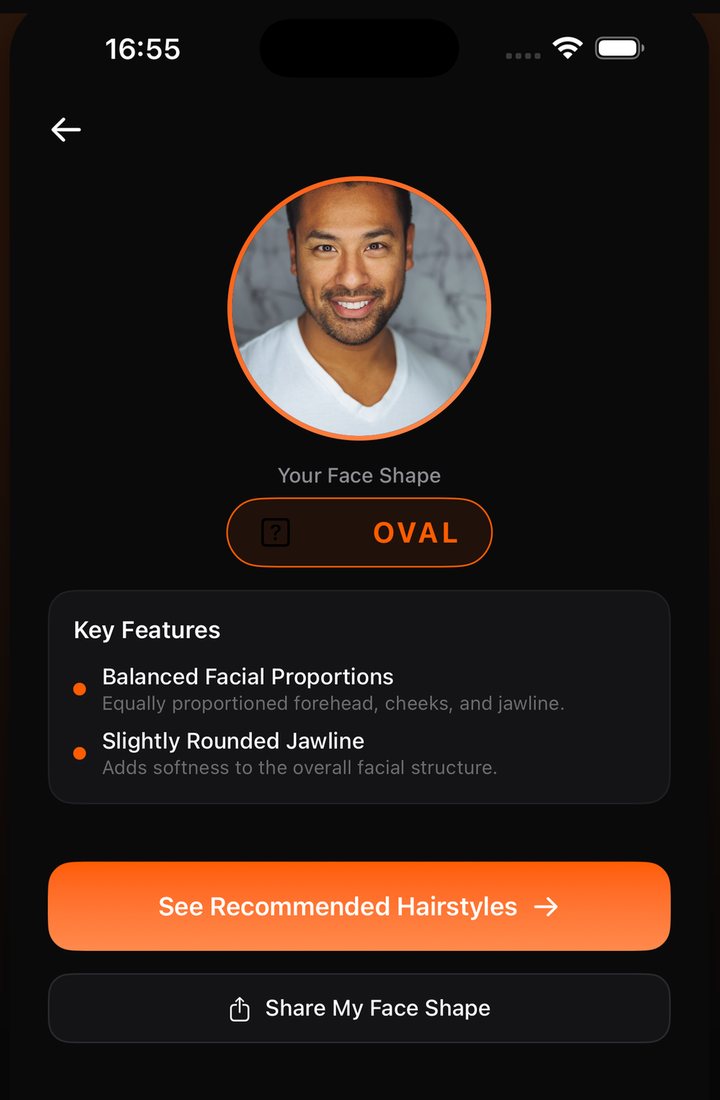
The one principle underneath all of it
Hair is the only part of your appearance you can change weekly, and it works by adding or removing visual mass in specific places. That is the whole mechanism. Every face-shape rule reduces to three moves:
- Add volume where the face is narrow — this evens out the silhouette.
- Remove or avoid volume at the widest point — adding width where you are already widest exaggerates the shape.
- Use vertical lines to lengthen and horizontal lines to shorten — a blunt fringe cuts the face horizontally; height at the crown extends it vertically.
If you remember only that, you can evaluate any haircut photo on your own, including the ones no guide has written about yet.
Oval face shape
An oval face is already balanced: no dimension dominates, and the jaw is neither sharp nor heavy. This is why it is described as suiting almost everything — and that is broadly true. Your job is not to correct anything, it is to avoid disturbing the balance you have.
What works
- Almost any length. Pixie, bob, lob, long layers — all sit well because nothing needs compensating for.
- Curtain bangs and side-swept fringes, which frame without shortening.
- Textured crops, quiffs and faux hawks for shorter cuts — added height reads as intentional rather than corrective.
- Blunt, one-length cuts, which showcase an even jaw-to-cheekbone line.
What to think twice about
- Heavy, full fringes that cover the forehead entirely. They shorten the face and can tip a balanced oval towards looking round.
- Very high volume at the crown combined with flat sides, which stretches the length you already have.
Because so little is off the table, the deciding factor for oval faces is usually hair texture and how much styling time you want — not geometry.
Round face shape
A round face has full cheeks and no hard jaw corner, with height and width close to equal. The goal is to introduce vertical lines and angles: length that falls past the widest point, and volume placed above rather than beside the cheeks.
What works
- Height at the crown — a quiff, pompadour, or simply lift at the roots. This is the single most effective move.
- A deep side part, which creates a diagonal line across the face and breaks the circle.
- Long layers that start below the cheekbone, keeping volume low and vertical.
- An angled or A-line bob that sits below the jaw, with the front longer than the back.
- Side-swept or curtain bangs, which frame diagonally rather than horizontally.
- For short cuts: a high fade with length left on top — the contrast narrows the sides and adds height at once.
What to think twice about
- A blunt chin-length bob, which lands its heaviest line exactly at the widest part of your face.
- A blunt full fringe, a strong horizontal line that makes the face read wider and shorter.
- Volume at the sides — bubbly curls at ear level, or a bob that flicks outward at the cheek.
- A flat centre part with no root lift, which frames the roundness symmetrically.
Square face shape
A square face has a strong, angular jaw and roughly even width from forehead to jawline. The conventional advice is to soften those angles — but a strong jaw is also one of the most sought-after features there is, so decide first whether you want to soften it or show it off. Both are legitimate, and they lead to opposite haircuts.
To soften the jaw
- Soft layers and waves around the jaw, which replace a straight line with a curved one.
- Length that falls past the jaw, usually collarbone or longer.
- Side-swept fringes and off-centre parts, adding a diagonal against the square.
- Rounded, textured crops for short hair, with the weight left slightly longer on top.
To emphasise the jaw
- A blunt bob cut level with the jaw, which deliberately echoes the line.
- Hair pulled back or a short buzz / crew cut, removing everything that competes with bone structure.
- A tight fade with sharp edges, the most direct version of the same idea.
What to think twice about
Heavy blunt fringes combined with a blunt jaw-length cut — two strong horizontal lines stacked above each other tends to read as boxy rather than as either soft or sharp.
Heart face shape
A heart-shaped face is widest at the forehead and tapers to a narrow, often pointed chin. The goal is to move visual weight downwards: less width up top, more fullness at or below the jaw.
What works
- Volume and length below the cheekbones — a chin-length or collarbone cut with body at the ends is close to ideal.
- Curtain bangs or wispy fringes, which cover part of a wide forehead without a hard horizontal line.
- A side part, which breaks the symmetry of a broad forehead.
- A bob that curves inward at the jaw, adding apparent width exactly where the face narrows.
- For short hair: a textured fringe left slightly longer at the front, rather than swept fully back.
What to think twice about
- Big volume at the crown or wide styling at temple height, which widens the already-widest part.
- Slicked-back styles that expose the full forehead — unless that contrast is the look you want.
- Very short layers ending above the cheekbone, which leave the chin looking narrower still.
Diamond face shape
A diamond face has dramatic cheekbones with a narrow forehead and a narrow chin — the least common of the six, and the one most often misidentified as heart or oval. The goal is to add width at the top and bottom so the cheekbones read as a feature rather than as the whole silhouette.
What works
- A fringe, which is the most direct way to add apparent width at a narrow forehead. Curtain, side-swept and soft blunt all work.
- Volume around the chin and jaw — a chin-length bob, or layers that flick outward at the bottom.
- Chin-length to shoulder-length cuts, which put mass where the face is narrowest.
- Deep side parts, softening the symmetry of the widest line.
- For short hair: a textured fringe forward rather than a swept-back crop.
What to think twice about
- Slicked-back styles with nothing on the forehead, which expose the narrow top and leave the cheekbones dominant.
- Volume at cheekbone height, which widens the widest point.
- Very short, tight crops with no fringe at all — the same problem as slicking back.
Oblong / rectangle face shape
An oblong (also called rectangular or long) face is noticeably longer than it is wide, with forehead, cheekbones and jaw at similar widths. It is the mirror image of the round-face problem: you want horizontal lines and width, and you want to shorten the visible forehead.
What works
- A fringe — the single most effective change available to you, because it directly shortens the visible length of the face. Blunt and curtain fringes both work.
- Width at the sides: waves, curls, or layers that build body around the cheeks and jaw.
- Mid-length cuts between chin and collarbone, which stop the eye travelling downward.
- A blunt bob, whose strong horizontal line counteracts the vertical.
- For short hair: a textured crop with a forward fringe, kept low rather than tall.
What to think twice about
- Long, straight, one-length hair with no layers, which draws a continuous vertical line.
- High volume at the crown — a tall quiff or pompadour adds length to a face that already has plenty.
- A centre part with flat sides, which frames and reinforces the length.
Where these rules stop applying
Face-shape advice is a useful heuristic, not a law, and it is worth being clear about its limits — most pages on this topic are not.
- Your hair's texture and density often matter more than your face shape. Fine hair will not hold the crown volume a round face theoretically wants; very thick, coarse hair will build width at the sides whether that suits you or not. When texture and geometry disagree, texture wins, because texture is what actually happens every morning.
- Growth patterns override plans. A cowlick at the front, a double crown, or a hairline that recedes at the temples will change how any cut falls. This is the main thing a stylist can see in person and an app cannot.
- Most faces are blends, and the closer you are to oval, the less any of this constrains you.
- "Flattering" is a convention, not a fact. These rules encode a preference for an oval silhouette. Plenty of the most striking haircuts deliberately break them — a blunt bob on a square jaw, a buzz cut on a round face — and read as confident rather than as mistakes. If you like the effect, the rule has done its job by telling you what the effect will be.
- Glasses, height, neck length and how you carry yourself all feed into the same visual equation and none of them are in the measurements above.
Use the geometry to understand why a cut looks the way it does on you. Then decide what you want it to say.
Seeing it before you commit
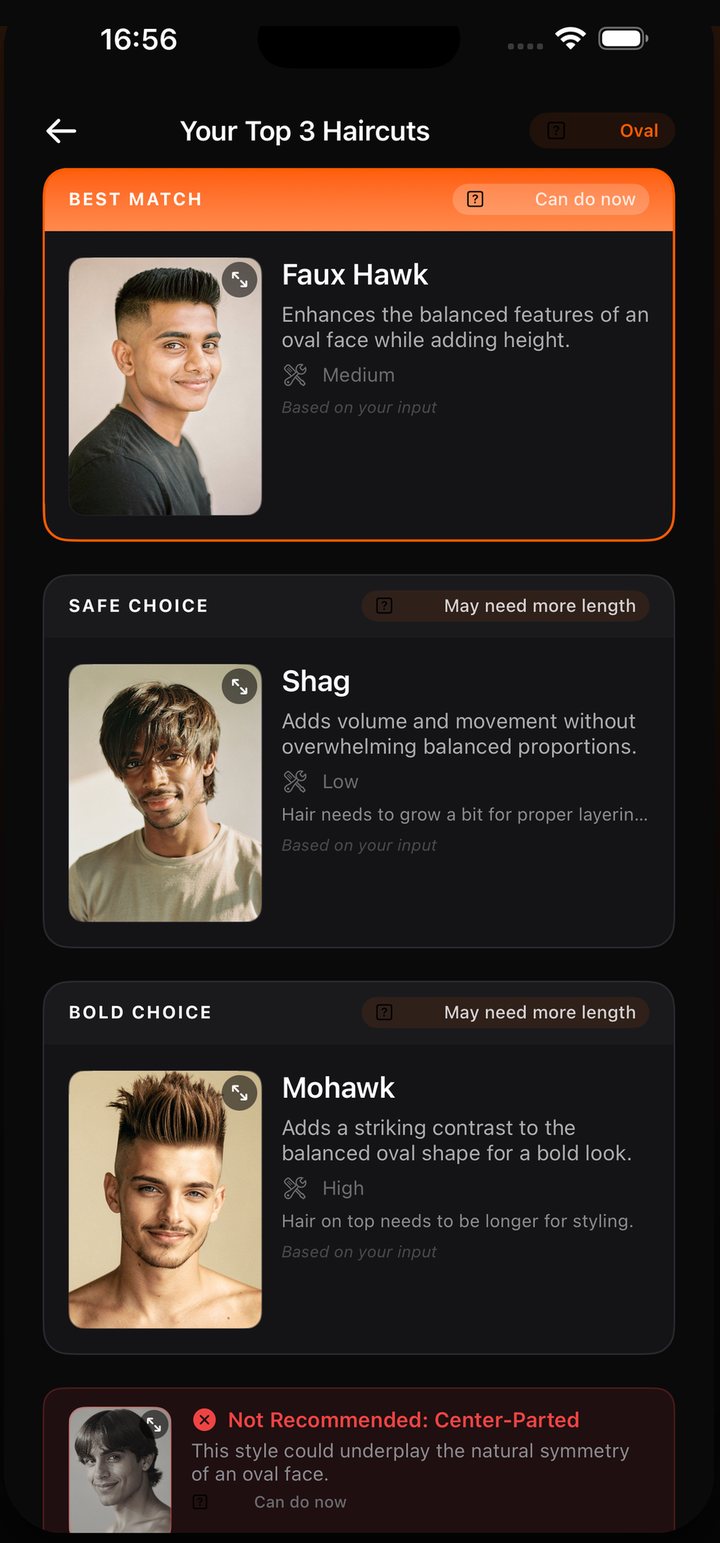
The gap between reading "long layers below the cheekbone" and knowing whether it works on your face is where most of the uncertainty lives. Two ways to close it: hold your hair in an approximation in front of a mirror and photograph it (covered in our guide to previewing a haircut before the salon), or generate the style on your own photo.
Disclosure
This page is published by the team behind HairMatch AI, an iOS app that classifies your face shape from a selfie, recommends cuts based on it, and previews each one on your own photo. The official app is App Store ID 6761456212. Everything above works perfectly well with a tape measure and a mirror — the app mostly saves you the measuring.
View on the App StoreCommon questions
How do I find out my face shape?
Pull your hair back and measure four things: forehead width, cheekbone width, jawline width, and face length from hairline to chin. Whichever measurement is largest, and how face length compares to width, identifies the shape — the table near the top of this page maps the combinations. Alternatively, an app can classify it from a front-facing selfie.
What face shape suits the most haircuts?
Oval, because its proportions are already balanced and no dimension needs compensating for. That is a statement about how few constraints apply, not about attractiveness — every shape has cuts that work beautifully on it.
What haircut makes a round face look slimmer?
Volume at the crown, a deep side part, and length that falls past the jaw. Together they add vertical lines and move mass away from the cheeks. Avoid blunt chin-length bobs and full blunt fringes, which both add horizontal emphasis at the widest point.
Do face shape rules apply to men's haircuts too?
Yes — the geometry is identical. A round face still benefits from height on top, which is why a high fade with length left on top is a common recommendation; an oblong face still wants a forward fringe rather than a tall quiff. Only the style names differ.
Can I have a fringe with a round face?
Yes, but choose the type carefully. Side-swept and curtain fringes work well because they create diagonal lines. A blunt, full fringe cut straight across is the one to be cautious with, since it adds a strong horizontal line at the widest part of the face.
What if I'm between two face shapes?
That is the normal case. Read both sections and follow the advice for whichever feature is more pronounced — for example a square-oval jaw takes the square advice about softening, while keeping the oval freedom on length.
Updated: September 2026.