ChatGPT hairstyle analysis: a working prompt, and when a dedicated app does it better
ChatGPT is genuinely good at the reasoning half of a hairstyle consultation: upload a clear front-facing photo, ask it to measure your proportions before it recommends anything, and you get a specific, explained shortlist for free. The prompt below is built to force that structure rather than a generic list.
Where it runs out of road is the seeing half. General image models struggle to regenerate a specific real person without their face drifting, so the picture you get back tends to be someone who resembles you — which defeats the point of a try-on, since the thing you are judging is how a cut sits on your face.
On this page
The prompt
Attach one clear, front-facing photo in even light with your hair pulled back, then send this:
Before you upload: a photo of your face sent to any AI assistant is subject to that service's data policy, and on some plans conversations may be used to improve models. Check the privacy and data-control settings of whichever assistant you use, and if you would rather not upload a face at all, the mirror-and-tape-measure method in our face shape guide reaches the same classification.
Why the prompt is structured that way
Three things in it do the heavy lifting, and they are worth understanding so you can adapt it:
- Observation before classification. If you just ask "what's my face shape?", you get a label and no reasoning, and you cannot tell whether it looked properly. Forcing it to state the measurements first means you can check the answer against your own face — and disagree with it.
- "Reference the specific measurements." Without this, recommendations drift into generic advice that could apply to anyone. With it, each suggestion has to be justified by something it claims to see in your photo.
- Explicit permission to say "I can't tell." Assistants tend to answer confidently even when an image is too dark or too angled to judge. Inviting the hedge makes low-confidence reads visible instead of buried.
Step 4 is the sleeper. The questions it asks back — how long is your hair now, how much styling will you actually do — are the ones that decide whether a recommendation is realistic, and answering them turns a generic reply into an actual consultation.
Three follow-ups worth sending
The first reply is the start of the consultation, not the end. These three get most of the remaining value:
1. Force a decision
"Between option 1 and option 2, which would you pick for someone who spends under five minutes on their hair in the morning, and why? Commit to one."
Assistants hedge by default. Asking for a commitment with a stated constraint produces a much more useful answer than a balanced comparison.
2. Get the six-week version
"What will each of these look like after six weeks of growth, and how often would I need it trimmed to keep the shape?"
Most haircut regret is really maintenance regret. This is the question people forget to ask a stylist too.
3. Write the salon brief
"Write me a short paragraph I can read out to a stylist, describing the cut in the terms a professional uses — length, layers, weight removal, fringe type, parting."
This is the single most practical thing ChatGPT does here. Translating "I want it kind of shorter and lighter" into salon vocabulary meaningfully reduces the chance of a miscommunication.
What ChatGPT is genuinely good at
Being straight about this matters, because a page that dismissed it would be wrong:
- Explaining the reasoning. It can tell you why a blunt jaw-length bob widens a round face, in terms you can then apply to any other cut yourself.
- Translating between vocabularies. Plain description in, salon terminology out. Very few tools do this well.
- Interrogating an idea. "Talk me out of a fringe" gets you a real argument, which is useful when you are two-thirds convinced.
- Being free and instant, with no download and no account beyond one you probably already have.
- Handling the follow-up conversation, which a fixed app flow usually cannot.
For a lot of people this is enough, and we would rather say so than pretend otherwise.
Where it stops
1. Identity drift in generated images
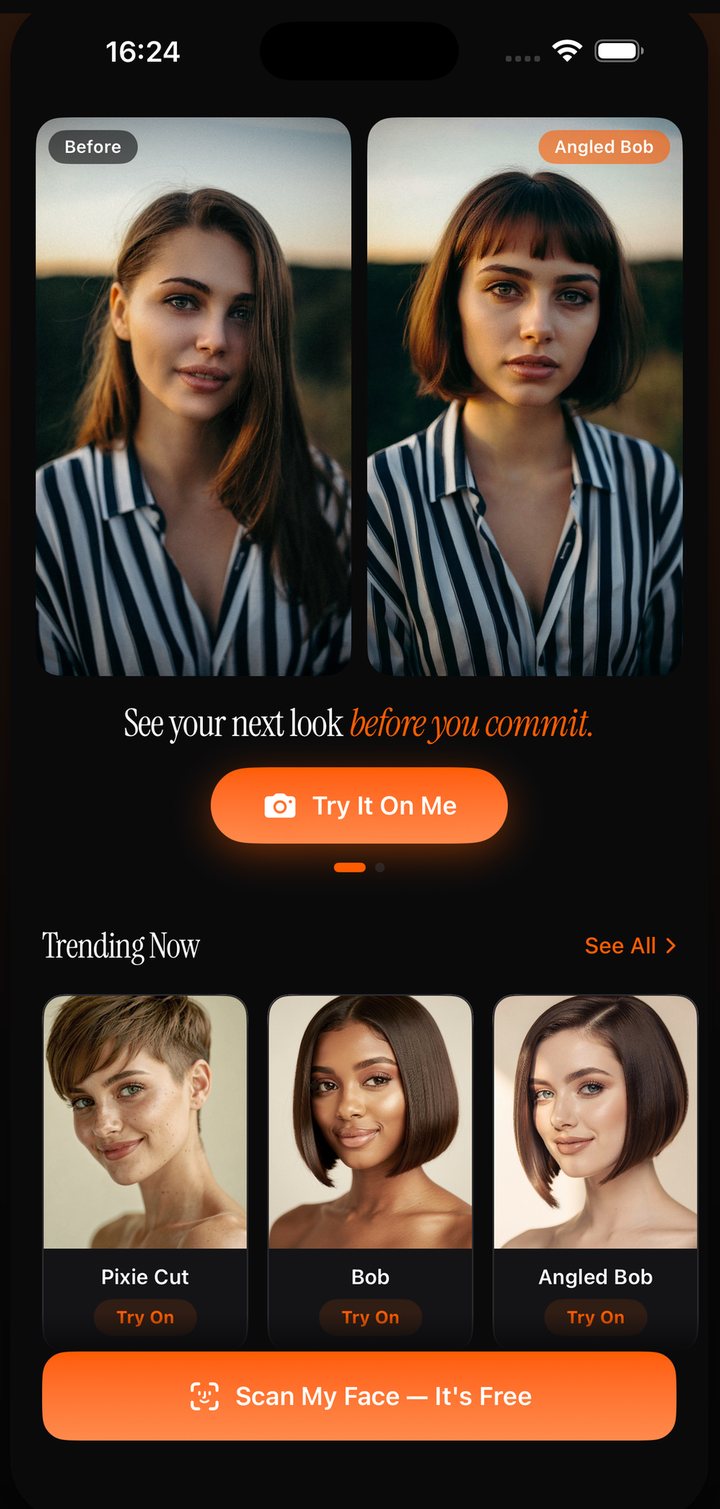
This is the main one. Modern general-purpose models can generate images, and they will happily produce a picture of "you" with a new haircut. But holding a specific real face constant while changing the hair is a hard, unsolved-in-general problem: features shift, the jaw softens, the eyes change spacing, and you end up looking at a plausible stranger.
That is fatal for this particular task. The entire value of a try-on is that the face underneath is yours — otherwise you are just looking at a haircut, which you could do on Pinterest for free. Purpose-built try-on apps constrain the generation to preserve identity, and it is the specific thing they are engineered around.
2. Inconsistency between runs
Ask twice with the same photo and you may get two different face-shape classifications, particularly for blended shapes like square-oval. There is no fixed rubric behind the answer, so the label can move with phrasing and with luck. The prompt above reduces this by demanding stated measurements, but it does not eliminate it.
3. No calibrated catalogue
A recommendation of "long layers" is a category, not a cut. A dedicated app maps to a specific, named, illustrated style with a known reference image — which is what you actually take to the salon.
4. It cannot see what a stylist sees
Worth stating plainly, because it applies to every app on this site as well: density, growth patterns, cowlicks, and how your hair falls when wet are invisible in a photograph, and they routinely override the geometry. Neither an assistant nor an app substitutes for someone putting their hands in your hair.
The sensible way to use both
These tools fail in different places, which makes them complementary rather than competing:
- Use an assistant for the reasoning. Run the prompt above, argue with the answer, get your shortlist down to two or three named cuts.
- Use a try-on app for the picture. Generate those specific cuts on your own photo, where identity is preserved and you can judge the silhouette against your real hairline and jaw.
- Use the assistant again for the brief. Follow-up 3 above, so you arrive able to describe what you want.
- Take both to a stylist and ask the only question neither tool can answer: will my hair actually do this?
Disclosure
This page is published by the team behind HairMatch AI (official iOS app: App Store ID 6761456212), which does step 2 above — face-shape analysis, then previews generated on your own photo. We publish a working ChatGPT prompt because it genuinely covers a lot of what people need, and a page that hid it in order to sell an app would deserve to be ignored.
View on the App StoreCommon questions
Can ChatGPT tell me what haircut suits me?
Yes, and reasonably well if you make it observe before it recommends. Upload a clear front-facing photo and ask it to state your forehead, cheekbone and jawline widths and your face length first, then classify the shape, then recommend cuts that reference those measurements. The full prompt is above.
Can ChatGPT show me with a different haircut?
It can generate an image, but keeping your actual face intact while changing the hair is unreliable — features tend to drift, so you often get a person who resembles you rather than you. For judging how a cut sits on your own face, a purpose-built try-on app that constrains generation to preserve identity gives a more trustworthy result.
Is ChatGPT accurate at determining face shape?
It is reasonable on clear, well-lit, front-facing photos and less reliable on blended shapes, where the same photo can produce different labels on different runs. Asking it to state the underlying measurements lets you check the classification yourself, which is the practical fix.
What is the best prompt for hairstyle advice?
One that forces observation before recommendation, requires each suggestion to cite the measurements it claims to see, and explicitly permits the model to say the photo is not good enough to judge. The prompt on this page is built around those three properties.
Is it safe to upload my photo to ChatGPT?
That depends on the service's data policy and your account settings, which are worth reading before uploading a face. If you would rather not, measuring your own proportions with a tape measure gives the same classification, and our face shape guide walks through it.
Updated: September 2026. AI assistants change quickly; the behaviour described here reflects general-purpose image generation as of this date.