How to preview a haircut on your face before the salon (free ways included)
There are five practical ways to see a haircut on your own face first: free social filters (Snapchat, Instagram, TikTok), the mirror-and-hair-tie test, asking a general AI assistant what suits your face shape, a free salon consultation, and an AI try-on app that regenerates your photo with the new cut.
The three free routes are good enough to rule styles out, which is most of the work. Pay for a generated preview only when you are down to two or three candidates and about to commit to a change you cannot undo for months.
On this page
A haircut is one of the few decisions where the trial is the commitment. Growing out a bad fringe takes three to six months; a length you regret can take a year. That asymmetry is why previewing is worth twenty minutes of effort, and why it is worth being honest about which methods tell you something real.
1. Social filters — free, instant, and shallow
Snapchat, Instagram and TikTok all host user-made hairstyle filters. Search the effects gallery for "hairstyle", "haircut" or a specific cut name like "bob" or "buzz cut" and you will find dozens, live on the front camera.
What they are good for: instant elimination. Ten seconds under a bob filter will tell you if short hair on you is unthinkable. That is a real answer, arrived at for free.
Where they fall down: the hair asset was drawn for a generic head and warped onto yours with face landmarks. It sits on top of your face rather than growing out of your hairline, so it cannot show you the one thing that decides most haircut outcomes — how the cut interacts with your own forehead, hairline and jaw. Filters also tend to be flattering by design, with smoothing and slimming baked in.
Use it like this: filters answer "could I ever?" Save the "should I?" question for a method that works with your real proportions.
2. The mirror test — free, and better than it sounds
Physically approximating a cut with what you already have costs nothing and is surprisingly informative, because it uses your actual hair.
- To test a short bob: tuck the length under and pin it at roughly jaw level, then look straight ahead in good light. You are checking where the ends land relative to your jawline.
- To test a fringe: pull a section forward over your forehead and hold it at eyebrow level. This shows how much forehead a fringe would cover — the single biggest variable for round and oblong faces.
- To test length off the face: pull everything back tightly. If your face reads well with no hair framing it at all, most cuts will suit you. If it does not, you know you need face-framing layers.
- To test volume: backcomb or scrunch one side only, then compare halves in the mirror.
Take a photo of each test with the front camera and compare them side by side later. Your live reaction in a mirror is unreliable; the photos are not.
3. Ask an AI assistant — free, and good at the reasoning part
A general-purpose assistant like ChatGPT, Claude or Gemini will happily analyse a photo you upload and explain which cuts suit your proportions, and why. The reasoning is genuinely useful and costs nothing on the free tiers.
What it does less well is showing you the result on your own face — identity tends to drift when a general image model regenerates a person. We wrote a full page on this, including a prompt that actually works and an honest account of where the approach stops being enough: ChatGPT hairstyle analysis — a working prompt, and when a dedicated app does it better.
4. A salon consultation — usually free, and the most reliable
Most salons offer a short consultation at no charge, and many will book one without an accompanying appointment if you ask. It remains the highest-quality preview available for one reason no app can match: the stylist can put their hands in your hair.
Density, growth patterns, cowlicks, how your hair falls when it is wet, whether your crown will hold a shape — these decide whether a cut works, and none of them are visible in a photograph. A stylist reading your hair in person for five minutes knows things no model can infer.
Bring reference images. Ask two specific questions: "will my hair do this?" and "what will this look like in six weeks?" The second question is the one people forget, and it is where most regret comes from.
5. AI try-on apps — freemium, and the closest thing to seeing it
These apps upload your selfie and use a generative model to redraw your photo with the new cut. Because the model has to render hair against your actual hairline and jaw, the output reflects your proportions rather than a generic head — which is exactly what filters cannot do.
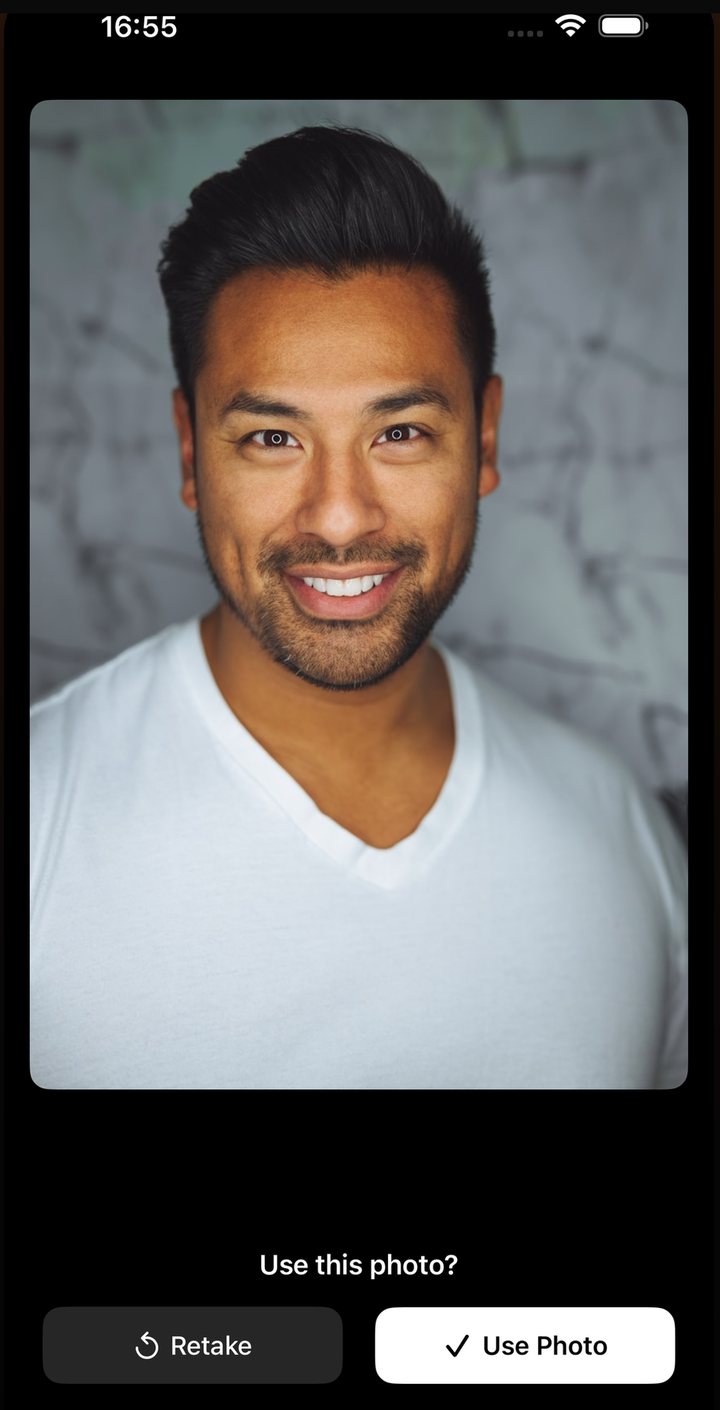
Practically all of them are free to download with a limited free allowance, then charge for further generations. That means you can usually see the output quality before paying anything — do that, on your own face, before you buy credits. A gallery of results on someone else's face tells you nothing about how the model handles yours.
For which apps do what, see what app shows how you'd look with a different haircut, or the side-by-side comparison of HairMatch AI, Glowify, Hair AI and YouCam.
Disclosure
This guide is published by the team behind HairMatch AI (official iOS app: App Store ID 6761456212), which is one of the apps in category 5. We have listed the free methods first and in detail because for a lot of people they are genuinely enough — and a page that pretended otherwise would not be worth reading.
View on the App StoreHow to take the photo (this decides everything)
Whether you are feeding an app, an AI assistant, or just comparing mirror tests, the input photo sets the ceiling on how useful the result is.
Do
- Face the camera square on, chin level
- Stand facing a window, or use even indoor light
- Pull hair back so your hairline is visible
- Neutral expression, mouth closed
- Plain background, phone at eye height
Don't
- Shoot from below — it widens the jaw and shortens the forehead
- Use overhead light — it drops shadows into the eye sockets
- Keep a hat, headband or glasses on
- Use a beauty filter or portrait-mode smoothing
- Use a three-quarter angle that hides one side of the hairline
The "shoot from below" mistake is the most common one and the most damaging: a phone held at chest height changes your apparent face shape, so the analysis and the preview both start from the wrong geometry.
Taking the preview to your stylist
A preview is only worth something if it survives the conversation at the salon. Three things make that go well:
- Bring two or three images, not one. A single reference reads as a demand; a small set reads as a direction, and lets the stylist pick what will work on your hair.
- Say the reference is AI-generated if it is. Stylists read reference photos closely, and knowing an image is generated tells them to read the shape rather than the strand detail. It also avoids the awkward moment where they try to identify a cut that does not quite exist.
- Describe the outcome, not just the picture. "I want it to look like this when I do nothing to it" is much more useful than the photo alone, because it tells them how much styling you will actually do.
Worth asking outright: "Is there anything about my hair that means this won't work?" A good stylist will tell you before they pick up the scissors, and that one question prevents most bad outcomes.
Common questions
What is the best free way to preview a haircut?
For eliminating options, a Snapchat or Instagram hairstyle filter takes seconds. For a decision you will act on, a free salon consultation is the most reliable, because the stylist can assess your hair's density and growth patterns in person — things no photograph reveals.
Can I preview a haircut without downloading an app?
Yes. The mirror-and-hair-tie test, a browser-based AI assistant, and a salon consultation all require nothing installed. Web-based try-on tools exist too, though quality varies and most ask you to upload a photo of your face — check the privacy policy before you do.
Are AI haircut previews realistic?
They are realistic about shape, length, and how a cut frames your face. They are not realistic about texture, styling behaviour, or how the cut will look after six weeks of growth. Judge the silhouette; ask a stylist about the rest.
How do I know if a fringe will suit me before cutting one?
Pull a section of hair forward and hold it at eyebrow level in front of a mirror in good light, then photograph it. Fringes hinge on forehead height and hairline shape, both of which this test shows you directly. Our face shape guide covers which shapes generally benefit from one.
Should I trust a preview enough to book the appointment?
Use it to narrow down and to communicate, not to decide alone. The strongest sequence is: rule options out for free, generate a preview of the two or three that survive, then take those to a consultation and let the stylist confirm your hair can do it.
Updated: September 2026.